


A few years ago, building a realistic conversational simulation required significant technical investment.
Today, you can create something that looks surprisingly similar in a few minutes.
Open a generative AI tool and type:
“You're an employee who's frustrated after receiving difficult feedback. Stay in character while I practice having the conversation with you.”
And just like that, you have a roleplay.
The employee responds.
You answer.
They react.
The conversation evolves.
It can feel remarkably real.
Which raises a reasonable question for any organization considering AI-powered practice:
Why not just build this ourselves?
It's a good question.
But it also exposes an important distinction.
Generating a believable conversation is not the same as designing a credible behavioral simulation.
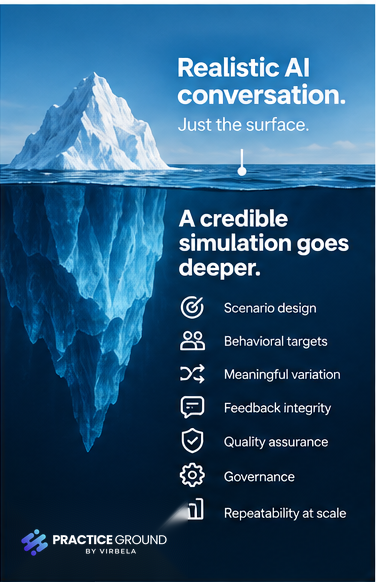
Conversation is only the visible layer
Generative AI is extraordinarily good at producing dialogue.
Give a model enough context and it can adopt a persona, respond naturally, introduce tension, ask questions, and adapt as a conversation unfolds.
That's valuable.
It's also only one piece of a simulation designed for development.
If someone is practicing a consequential workplace conversation, there are other questions that matter.
What capability is the scenario intended to develop?
What should someone actually have an opportunity to demonstrate?
Which behaviors are relevant?
What kinds of responses should the scenario produce?
How much variation is useful—and how much undermines the purpose of the exercise?
How should performance be interpreted?
What feedback should the learner receive?
What happens when the learner takes an approach the designer didn't anticipate?
And can the experience continue to work as intended across hundreds or thousands of conversations?
Those questions are harder than generating dialogue.
A realistic conversation can still be a bad simulation
This distinction matters because realism can be convincing.
If an AI character sounds human, pushes back appropriately, and creates an emotionally engaging conversation, the experience can feel effective.
But realism alone doesn't tell you whether the learner practiced what you intended them to practice.
Imagine a manager-development simulation designed around a difficult workplace situation.
The learner navigates it smoothly. The simulated employee ends the conversation feeling positive. Everyone appears satisfied.
Was that good leadership?
Maybe.
Maybe not.
A consequential leadership conversation doesn't always end with emotional harmony.
Sometimes good leadership requires establishing a clear standard.
Sometimes it means communicating a decision someone dislikes.
Sometimes it requires refusing a request.
Sometimes it means acknowledging uncertainty rather than offering reassurance.
Sometimes it means escalating an issue rather than resolving it yourself.
A simulation that simply rewards warmth, agreement, or a happy ending may produce a pleasant experience without actually providing meaningful leadership practice.
There shouldn't always be one “right” conversation
The opposite problem can happen too.
A simulation can become so tightly designed around a preferred response that the learner is effectively trying to discover the hidden script.
That's not particularly realistic either.
Real leadership rarely has one perfect sentence.
Different situations call for different approaches, and sometimes more than one approach can be legitimate.
That's why good behavioral simulation design has to distinguish between what someone says and what they're demonstrating through the conversation.
The objective shouldn't be to train managers to reproduce a script.
It should be to give them opportunities to exercise judgment.
Then comes the measurement problem
Generating dialogue is one job.
Understanding what happened in the conversation is another.
And providing useful developmental feedback is another still.
Those functions can look seamless to the learner, but they solve different problems.
If an organization wants to move beyond “the learner completed a roleplay,” it needs a way to think systematically about what happened during that practice.
What evidence appeared in the conversation?
How does it relate to the capability being practiced?
What should the learner understand afterward?
And how do you avoid turning nuanced human behavior into an overly simplistic score?
At Practice Ground, these questions are central to the design of the experience.
The goal isn't simply to produce a convincing AI conversation.
It's to create practice that helps people build capability.
Scale introduces another challenge: consistency
A single impressive demo is relatively easy.
A reliable library of simulations is harder.
Once practice is deployed across an organization, learners won't all behave the same way.
They'll ask unexpected questions.
Ignore obvious cues.
Take the conversation in new directions.
Use different communication styles.
Make choices the scenario designer never anticipated.
Meanwhile, the AI models powering these experiences continue to evolve.
That means behavioral simulations require ongoing testing and quality assurance.
Does the scenario still create the intended opportunity to practice?
Does it handle legitimate variation appropriately?
Does the feedback remain aligned with the development target?
Can learners take different reasonable approaches without breaking the experience?
These aren't questions you answer once when you write the initial prompt.
They're part of maintaining the simulation.
So, should organizations build their own?
Sometimes, perhaps.
An organization with the right internal expertise, infrastructure, development resources, governance model, and willingness to maintain the system may reasonably decide to build its own simulation capability.
The build-vs-buy question shouldn't be answered by pretending otherwise.
But organizations should be clear about what they're choosing to build.
If the objective is simply to give employees a conversational AI character to practice with, the barrier has become remarkably low.
If the objective is a scalable behavioral practice program, the requirements are different.
You're not just building a chatbot.
You're designing scenarios.
Defining development targets.
Creating meaningful variation.
Thinking through behavioral evidence.
Designing feedback.
Testing edge cases.
Establishing governance.
Running QA.
And maintaining all of it as the technology underneath it changes.
That's a different investment.
The conversation is the easy part
Generative AI has changed what's possible in learning and development.
It has made realistic, scalable conversational practice possible in a way that simply wasn't practical before.
That's exciting.
But it also means buyers need to look beyond the most impressive part of the demo.
Don't just ask whether the AI sounds human.
Ask:
What is the learner actually practicing?
What makes the scenario credible?
What happens when the learner takes an unexpected approach?
How is feedback generated?
How is the experience tested?
And what evidence do you have that the simulation is doing what it was designed to do?
Because the ability to generate a conversation is no longer particularly rare.
The harder (and more important) work is turning that conversation into meaningful practice.
That's what we're building at Practice Ground by Virbela.
AI-powered practice for the conversations that shape work.


.jpg)
